Our September 11, 2007 marks the Ethiopian New Year (Enkutatash), and the Millennium (2000) starts on September 12.
Obviously, Ethiopia runs on a very different calendar from ours. Here's some background:
Ethiopia still retains the Julian calendar, in which the year is divided into 12 months of 30 days each and a 13th month of 5 days and 6 days in leap year. The Ethiopian calendar is 8 years behind the Gregorian calendar from January to September and 7 years behind between September 11 and January 8.
Enkutatash means the "gift of jewels". When the famous Queen of Sheba returned from her expensive jaunt to visit King Solomon in Jerusalem, her chiefs welcomed her bolts by replenishing her treasury with inku or jewels. The spring festival has been celebrated since this early times and as the rains come to their abrupt end, dancing and singing can be heard at every village in the green countryside.
But Enkutatash is not exclusively a religious holiday. Today's Enkutatash is also the season for exchanging formal new year greetings and cards among the urban sophisticated - in lieu or the traditional bouquet of flowers.
source: http://www.tourismethiopia.org/pages/detail/detailfestival.asp
Other facts about Ethiopia:
Location : East Africa
 Land Area : 1,128,200 square km.
Population : 72,851,281 and population density is 51.8 persons per square km.
Main Language : Amharic - the only written language in Africa with its own unique script
Capital City : Addis Ababa, founded in 1889
Major Religion : Orthodox Christianity and Islam
Calendar : Ethiopia follows the ancient Christian calendar and will start the new millennium on 12 September 2007
Time : Three hours ahead of Greenwich Mean Time. Because Ethiopia is close to the equator, there is an almost constant twelve hours of daylight and time
Climate : Despite its proximity to the Equator, Ethiopia's high altitude ensures a temperate, moderate, even chilly climate
Currency : Ethiopia's currency is known as Birr, and according to current exchange rates, 1 Birr buys about 0.125 US dollars
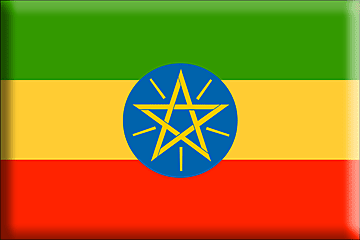
Flag : Horizontal stripes of green, yellow and red
 Age : One of the most ancient countries in the world with cultural and historical records dating back more than 3000 years
There were times when Ethiopia's prominence reached its climax on several occasions; times when Ethiopia inspired the world as one of the pioneers of early civilization, not to mention its reputation as the cradle of mankind. And there were times when its eminence hit rock bottom; times when Ethiopia unwillingly developed certain notoriety for being a land of despondency. Good days have come and so have bad ones, because good days, bad days, they come and they go.
Yet Ethiopia has gone the distance from the early days of its ancient civilization to the present, to make it to another millennium of its own and with all its pride intact. The concluding millennium has seen Ethiopia prosper and decline both politically and economically. It has been fortunate and unfortunate.
The new millennium, on the other hand, gives Ethiopia a chance to reflect on the past and an incentive to move forward and energize. So it is time to celebrate believing that things will change for the better as of the new millennium.
source: http://www.ethiopianmillennium.com/index.html